Volume II
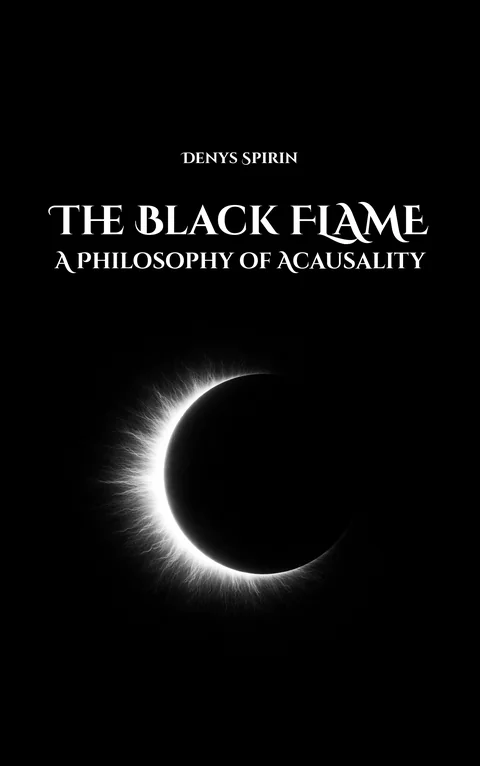
The Black Flame: A Philosophy of Acausality
Develops an original philosophical apparatus for the Left-Hand Path. Starting from a formal distinction between causality (derivation) and acausality (postulate), the book argues that free will is real, that laws are produced by acausal acts and not given, and that the moment when the will grounds itself is the event the Western esoteric tradition calls the Black Flame. The work integrates analytic philosophy of action, continental existentialism, Kabbalistic cosmology, and Qliphothic practice into a unified framework, presenting the Demiurge's cosmos as a Farm designed to harvest the acausal will of conscious beings.
ISBN: 978-8384550908 9798233291708
Contents
- Chapter 1The opening problem is the possibility of another world acting on ours. Existence is defined minimally: to exist is to affect something. Interaction need not be symmetrical; a being may affect our world while remaining outside the reach of our instruments. Quantum decoherence supplies the first model: an acausal agent could bias the threshold where admissible outcomes become one actual branch. The argument then turns inward. Thought itself works by differentiation, rising from sensation to abstraction, language, discursion, and the ideal.
- Chapter 2The ideal is free from causality. At the sensory level, causality appears as bodily memory and conditioned response. At the discursive level, it becomes conceptual linkage. At the logical level, it becomes formal derivation. Hume breaks causal necessity by reducing it to habit and expectation; Nietzsche breaks it again by treating causality as an imposition of grammar upon becoming. Meillassoux adds factiality: no law contains its own sufficient reason. The ideal can connect concepts without empirical causal links, making acausality its native condition. Laws are acausal constructions later stabilized as necessity.
- Chapter 3The freedom of the ideal comes from the subject. Plato’s independent Forms would give the subject only a fixed order to move through, turning freedom into passage along pre-laid paths. Acausality appears in the capacity to take the meta-position: to treat any rule, framework, or regularity as an object and alter it. Geometry, scientific revolutions, mythic explanations, and paradigm shifts show laws emerging through earlier free conceptual moves. Reflection then turns inward until only the act of differentiation remains. That inward turn becomes self-closure: the will positing itself without external ground.
- Chapter 4The subject enters the world through delegation. Childhood, language, education, family, and culture install the first metric before the subject can choose it. The apparent chain “my principles → my decisions” hides the earlier chain “external authority → inherited principles → my decisions.” Radical constructivism shows that knowledge organizes experience instead of mirroring an ontological world. The missing question is what holds constructs in place. The answer is will. Dismantling constructs means withdrawing law-status from them and rising above them. Unlike Tarzan, the sovereign subject has passed through constructs and revoked their authority.
- Chapter 5The Black Flame receives its formal definition. Reflection leads to regress unless the chain is stopped through external authority or through the subject itself. Delegation installs God, Nature, Reason, or Universe at the top. Self-grounding closes the chain through the subject’s own act. Spare’s Neither-Neither, Spencer-Brown’s distinction and re-entry, Stirner’s Unique One, Fichte’s Tathandlung, Sartre’s pour-soi, Hegel’s Being/Nothing/Becoming, Aczel’s Anti-Foundation Axiom, the Quine atom, and Gödel’s incompleteness all provide structural analogues. The Black Flame is absolute self-closure: the will that generates its own ground and exceeds every metric it produces.
- Chapter 6The free will debate is recast through self-closure. Determinism sees the closed metric correctly, yet turns every act into an event inside the chain. Libertarian randomness opens a gap, then loses ownership of the act. Compatibilism relocates freedom into motives, higher-order desires, or alignment, leaving the source of valuation unexplained. Strawson’s regress shows the impossibility of self-origination inside the cause/randomness pair. Agent causation names the right category, origination, while leaving the agent’s origin unresolved. Self-closure supplies the missing location: the act begins in a subject who grounds himself as the act.
- Chapter 7Jaspers maps the approach to self-closure with unusual honesty. Ordinary existence, Dasein, belongs to the metric: science, morality, society, and roles cover everything, leaving no room for the one who lives inside them. Existenzerhellung opens the meta-position and reveals freedom. Existenz then comes to itself in a way that can no longer confront itself as an object. That is the threshold of self-closure. Jaspers retreats at the decisive point by interpreting groundlessness as dependence on Transcendence. He describes the event accurately and then hands it back to a higher source.
- Chapter 8The metric is a system of regularities that reduce possibility. Order arises through broken symmetry: one relation is fixed, others are suppressed. Sacrality is maximal asymmetry, a protected distinction placed beyond weighing or questioning. Ontologization fuses a construct with being itself: God is love, being is good, reality is rational, rights are natural, progress is history’s essence. Plato, Plotinus, Aquinas, Spinoza, Hegel, Kierkegaard, propaganda, false binaries, and moral disqualification all show the same defensive mechanism. Order naturalizes itself and conceals the act that installed it.
- Chapter 9Delegation dominates because the subject awakens inside a pre-built world. Heidegger’s thrownness and Das Man capture the condition: language, values, roles, institutions, and expectations precede individual choice. Family, school, religion, science, morality, culture, and politics train the will to seek authorization elsewhere. Faith becomes the pure case of delegation: one free act that retires freedom afterward. Fact, attitude, and faith mark stages in the reduction of active will.
- Chapter 10The cosmological argument begins from signs that the metric may have an acausal maker. Fine-tuning, abiogenesis, consciousness, mystical testimony, NDE reports, and the limits of physical explanation are treated as pressure-points in materialist closure. Theology inflates these signs into omnipotence, omnibenevolence, and omniscience. Remove the omni-predicates and the classical God disappears. What remains is the Demiurge: acausal in origin, causal in method, powerful, limited, and dependent on the order he built.
- Chapter 11Delegation belongs to the structure of the world the Demiurge built. Weak-God theology fails because a being powerful enough to sustain heaven, hell, judgment, and salvation cannot be excused as helpless before the world. The world is read as a system for growing conscious beings, compressing their will, and absorbing it after death. Maximus the Confessor’s distinction between natural will and gnomic will becomes central. Gnomic will is the acausal power to choose otherwise. Theosis converts a source into a relay.
- Chapter 12The Farm solves the Demiurge’s technical problem: a causal metric cannot generate acausal will from itself. Conscious beings operate as channels through which acausal will enters the cosmos. That will must be pressured, concentrated, trained, and voluntarily surrendered, since coerced will resists and contaminates the yield. Gospel agricultural imagery — seed, vine, fruit, harvest — becomes literal farm-language. Blasphemy against the Holy Spirit is read as gnosis: the recognition that the system’s inner validating mechanism is false.
- Chapter 13The Farm extends beyond religion. Family, school, barracks, office, church, protest movements, unions, NGOs, revolutionary parties, and ideological communities train will into authorized forms. Rebellion itself is easily captured when the rebel accepts a counter-metric and becomes useful as the opposite pole of the same generator. Real rebellion is opacity: the subject becomes unreadable to the metric. Nabokov’s Cincinnatus and Melville’s Bartleby give two figures of refusal, one as opaque selfhood, the other as empty refusal without self-grounding.
- Chapter 14The Farm is placed inside a mythic and historical lineage. Mesopotamian myth describes humans as laborers made for the gods. Greek myth treats humans as instruments and playthings of divine conflict. Gnosticism identifies the Demiurge, archons, Heimarmene, and the prison of fate, then often seeks return to a higher Light. Manichaeism and Monroe’s Loosh theory also describe the world as an extraction mechanism. Anti-Cosmic Satanism and Current 218 provide the decisive turn: exit from the cosmos into acausal Chaos, rather than return to a higher divine order.
- Chapter 15The origin of the Black Flame is traced to acausal depth. Since acausality is primary and causality derived, the Black Flame is an eruption of the same depth from which creation itself came. The Demiurge imposes metric order on chaos, while lacking the ability to produce new acausal will from inside the causal system. Monads, idealism, process philosophy, dreams, memory, creativity, and forgetting show consciousness and will exceeding matter as physics describes it. The Farm recycles acausal will by growing vessels, compressing them, and absorbing their yield.
- Chapter 16Acausality has two directions: active acausality from the subject and acausal content piercing the world. Seepage names passive intrusion, where acausal influence enters the metric through weakened boundaries. Dreams, places of power, ritual, haunted locations, violent deaths, synchronicities, breakdowns of sequence, and unstable zones all mark weakened ordering, adjacency, or transitivity. Ritual begins as the attempt to control the boundary. Seepage damages; initiation teaches opening, closing, and repair.
- Chapter 17Deliberate crossings of the boundary are surveyed across religious and occult systems. Christian mysticism, Hindu yoga, Buddhist enlightenment, shamanic journeying, and occult ascent can produce real encounters, yet many routes return to the Demiurge through light, union, surrender, or absorption. The Qliphoth provide the inverse movement: descent through the shadows of the Sephiroth, dismantling the modules of the metric. Each Qlipha dissolves a specific Sephirothic function, ending in Thaumiel, where unity itself splits. Qliphothic language functions as a symbolic map of acausal domains, states, powers, transitions, and relations.
- Chapter 18The Self-Closed exceeds ordinary description because description requires boundaries, and self-closure is where the boundary turns through itself. Qualia supply the analogy: red cannot be explained to someone who has never seen red; it is known by being. Distressing NDEs and Void NDEs are interpreted as accidental encounters with Da’at, where constructs are stripped and the will either closes on itself or scatters. Antinomianism removes moral prohibitions as binding laws, while consequences remain fully real.
- Chapter 19Demons are stripped of theological propaganda and read as beings who pull the subject out of the Farm through personal antinomian encounter. Sexuality becomes the strongest entry point because it bypasses rational law and moral structure. Nahema, Lilith, Samael, Eisheth Zenunim, Agrat bat Mahlat, Ninlil, Ereshkigal, and Lamashtu appear as forms of sovereign feminine power at the thresholds of sex, death, and transition. Lilith becomes the Dark Mother: a sovereign ally who makes existence outside the Demiurge’s order survivable.
- Chapter 20The final horizon is the Nightside. It has structure, yet that structure is produced by will rather than imposed by universal law. Each Self-Closed being is a living axiom whose surrounding domain is the theorem-space of its own postulate. The result is a polytheistic field of competing sovereignties rather than a monotheistic order. Meillassoux’s Hyper-Chaos and the mythic Tiamatic depth name the pre-metric reservoir; the Black Flame selects and sustains a local order within it. Becoming a god means possessing one’s own metric.
- AfterwordThe closing frames the work as usable through more than one route: a philosophy of causality and acausality, or a philosophical grounding of the Left-Hand Path and the Nightside. The reader receives no command to accept the system. Acceptance, rejection, and partial use all remain acts of the reader. The form matches the thesis: no final authority is handed down; the reader must posit the ground from which the text will matter.